

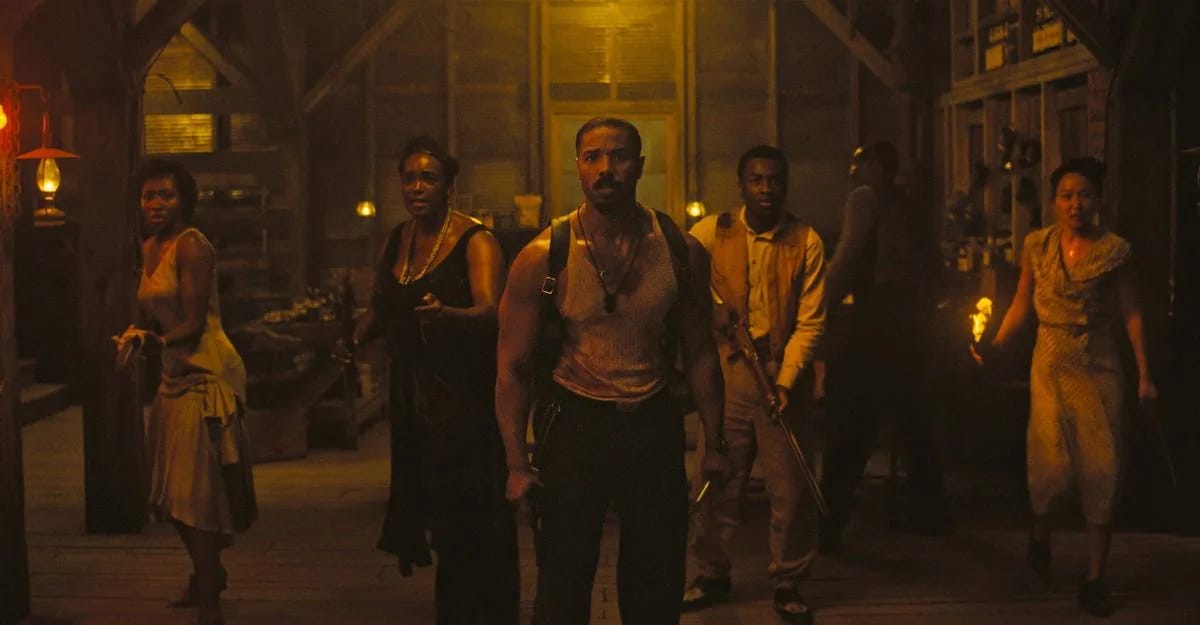
The vampire has been cinema’s eternal nomad, drifting through time with fangs bared and seduction in its step. But every so often, the creature is reborn—not just with sharper teeth or sexier clothes, but with a new soul. Sinners, Ryan Coogler’s first foray into horror, doesn’t just resurrect the genre. It lays it bare. It carves into it with a gospel knife, sings over its corpse, and turns it into something alive again. Something howling. Something holy.
Set in the sweltering aftermath of World War I in Mississippi, Sinners is less a movie and more a spiritual reckoning. It pulses with memory—Black memory, ancestral memory—and aches with the pain of things lost: lives, land, legacy. Coogler doesn’t just direct a horror film here. He preaches one. And in doing so, he reminds us that horror, at its most powerful, is not about what jumps from the shadows, but about what lingers in the light. What we see and do nothing about. What we forget.
At the center of this fever dream are the twin brothers Smoke and Stack, both played with mesmerizing control by Michael B. Jordan. One brother is fire, the other ash. One wants peace, the other revenge. Jordan doesn’t simply differentiate them with mannerisms—he imbues them with entirely separate rhythms of breath, of grief. Their return home from war isn’t a victory march—it’s an exhumation. And what they unearth is a town not just haunted by racism and violence, but stalked by something older. Hungrier.
The story unfolds through the weary, unflinching gaze of the twin brothers, who return to Mississippi scarred by war and sharpened by years in Chicago’s criminal underworld. Their mission is simple: transform a rundown lumber mill into a juke joint—a sanctuary for joy, music, and Black autonomy. They bring with them not just grit and swagger, but a willingness to confront anyone in their way, regardless of race. This is about reclaiming space, sound, and identity.
To bring their vision to life, they turn to their younger cousin, Preacher boy Sammie—played by newcomer Miles Caton in what can only be described as a staggering debut. Caton moves through the film with the ease and presence of someone who’s been acting for decades. There’s a lived-in quality to his performance, a quiet gravitas that never feels forced. Sammie acts as both compass and connective tissue—he knows who to trust, where to go, and what still matters in a town haunted by history. Whether he’s hauling crates of bootleg gin or gripping a shotgun with trembling resolve, Caton’s portrayal is layered, deeply human, and unforgettable. It’s the kind of breakout that announces not just talent, but staying power.
Together, they gather the ensemble cast in a purposeful ramble that maps the geography of their old haunts: lush cotton fields, a bustling train station, segregated storefronts still echoing with ghosts. Arkapaw and Coogler envelop the audience into this world with propulsive oners and a gorgeously balanced blend of wide-screen Southern Gothic and intimate close-up confessionals. By the time ornery musician Delta Slim (Delroy Lindo), towering bouncer Cornbread (Omar Benson Miller), Smoke’s ex-wife Annie (Wunmi Mosaku), and the grocers Bo (Yao) and Grace Chow (Li Jun Li) have all been roped in, we’re not just watching. We’re residents.
But what truly sets Sinners apart—what makes it feel urgent—is its women. Women in horror are too often either meat or martyr. But here, they are neither. They are soul. They are spine. They are the echo that never dies.
Take Pearline, played with raw magnetism by Jayme Lawson. Her voice doesn’t just sing—it testifies. When she performs “Pale, Pale Moon,” the entire room stills, and you realize that the vampire isn’t the only one capable of casting spells. Pearline is not a side character. She is the emotional fulcrum, the pain and passion wrapped into a single refrain. And she holds the screen like she owns it—because in many ways, she does.
Then there’s Annie, Smoke’s ex-wife, played by Wunmi Mosaku in a performance so quietly towering it practically reshapes the film around her. Annie is no mere echo from Smoke’s past—she’s a force of memory and marrow, a woman who’s endured more than most, and who refuses to let the past define her future. Mosaku brings a lived-in depth to every frame she inhabits. Her silences are loaded, her glances devastating. There’s a moment—no music, just her and the weight of a life half-lived—when she stands in the juke joint alone under the flicker of lamplight, and you can feel generations of pain and perseverance ripple through her. It’s haunting. She doesn’t demand attention—she commands it, with precision and grace. Mosaku is the film’s quiet storm, and Sinners wouldn’t hit nearly as hard without her anchoring presence. She’s the kind of performer who makes you lean in, makes you feel, and then leaves you shattered.
And Mary. Hailee Steinfeld plays her with a trembling complexity that turns what could’ve been a flat archetype—White-passing girl caught between worlds—into something tender, painful, and deeply human. Her scenes with Stack crackle not with romance, but with the ache of the unrealized. She’s both a bridge and a wound, a woman who knows she’s both seen and invisible. That kind of layered female character work is so rare in horror that it feels revolutionary.
Even beyond these three, Sinners is filled with women who live. Grocers Grace Chow and Bo Yao aren’t background—they’re resistance in action. Pearline’s sister, silent for much of the film, becomes a fury in the third act, wielding her grief like a weapon. This film remembers its women. Not as victims, not as saints, but as flesh-and-blood beings whose voices shape the world. That alone makes it unforgettable.
And then—finally—the vampires come. When they enter, it isn’t with snarls, but with style. Remmick (Jack O’Connell) and his sired cohorts, Joan (Lola Kirke) and Bert (Peter Dreimanis), arrive not as monsters, but as musicians. Predators disguised as poets. What Coogler does here is terrifying in its precision: he reframes the vampire not just as the undead, but as the cultural thief. They steal rhythm. They steal soul. They drain Black expression and sell it back in pale imitation.
There’s a particularly gutting scene where Joan softly hums a blues tune Pearline had just performed. It’s beautiful, yes—but it’s theft. That quiet moment of artistic hijacking lands harder than any fang to the neck.
Ludwig Göransson’s score threads it all together with transcendence. It isn’t just music—it’s memory. A lament, a shout, a prayer. One track melds gospel harmonies with sliding blues and the eerie hum of vampiric hunger, and it becomes clear: this film is about sound as survival. About music as the last thing they can’t take from you—until they do.
The final act, soaked in blood and fire, doesn’t just climax—it rises. It feels earned, not for its violence, but for its liberation. When Smoke and Stack make their final stand, it’s not just against vampires. It’s against the erasure of everything they are. And when Pearline picks up a broken guitar string and screams into the void, it’s as if generations are roaring through her.
Sinners is a film that aches, that sings, that bares its teeth. It’s messy—yes, even overly ambitious at times—but that mess is its heartbeat. Its imperfections give it soul. In a genre that so often forgets the power of women, of Black culture, of music as resistance, Sinners doesn’t just remember—it reclaims. It’s a revelation.
I just rewatched this on Thursday and realised I never read your review - this is beautiful. I especially love how you analysed the female characters; they (and the rest of the cast) are so well-developed and feel like real, believable people in a way that we often don't see in horror, and honestly after reading your perspective, I feel like I appreciate them and the film even more as a result. Amazing stuff!
Fantastic review Cody ;)